reamz45
Building Future-Ready Supply Chains with Custom Logistics Software Development Services

Modern global supply chains operate in an era where speed, visibility, and accuracy determine market leadership. Off-the-shelf software products often force businesses to conform to generic workflows, logistics software development services to operational friction, expensive per-seat licensing, and rigid integration barriers. To gain a true competitive advantage, forward-thinking enterprises are turning toward tailored digital platforms. Partnering with a specialized custom logistics software development company allows organizations to build modern infrastructure engineered specifically for their unique business rules and growth targets.
By leveraging specialized logistics software development services, companies can replace disjointed legacy platforms with unified, high-performing systems. These digital solutions automate manual processing, enhance real-time freight visibility, and optimize routing across complex supply networks.
The Strategic Power of Custom Logistics Software Development
Off-the-shelf logistics platforms are typically created for the average enterprise. They contain fixed features that may not match specialized carrier networks, custom rating structures, or multi-location facility setups. Custom logistics software development bridges this operational gap by delivering a tailor-made digital foundation configured around your actual business processes.
When enterprises invest in custom logistics software development services, they unlock several key business advantages:
- Complete System Integration: Connect seamlessly with existing ERPs like SAP, Oracle, and NetSuite, along with specialized WMS tools, carrier APIs, and e-commerce storefronts without paying external middleware fees.
- Complete Code Ownership: Retain 100% ownership of your source code. Eliminating per-user seats or per-shipment fees prevents ballooning operational costs as transaction volumes scale.
- Tailored Business Rules: Digitalize custom rating engines, multi-tier SLA tracking, slotting logic, and automated compliance verification to match exact operational requirements.
- Advanced Security Standards: Protect sensitive freight data, carrier contracts, and consumer information using enterprise-grade security protocols, including ISO 27001 certification and SOC 2 compliance.
- High Cloud Scalability: Deploy microservices architectures on AWS or Azure designed to auto-scale effortlessly during peak seasonal surges without performance degradation.
Core Pillars of Comprehensive Logistics Platforms
Modern supply chain ecosystems require connected modules that work together seamlessly. A comprehensive transportation and logistics software development company delivers fully integrated components that cover every stage of the fulfillment cycle.
Transportation Management Systems
An advanced transportation management system acts as the central command hub for moving goods. It automates order intake, dynamic load planning, carrier selection, freight settlement, and electronic tendering. Embedded artificial intelligence helps rate engines connect to dozens of carrier APIs simultaneously, ranking options based on cost, transit speed, past performance, and live capacity in milliseconds.
Cloud Warehouse Management Systems
Efficient inventory control requires granular visibility across every distribution center and storage facility. Custom warehouse management tools incorporate automated putaway, cycle counting, picking optimization, and RFID tracking. Unifying warehouse operations into a single operational view minimizes picking errors and speeds up order fulfillment cycles.
Multi-Carrier Shipping and Fleet Analytics
Multi-carrier shipping engines empower organizations to shop real-time rates across parcel, LTL, FTL, and intermodal transport providers. Automated label generation, customs documentation, and branded tracking portals keep customers informed at every step. Simultaneously, fleet management platforms incorporate GPS telematics to deliver live driver routing, fuel management, maintenance schedules, and hours-of-service compliance tracking.
Supply Chain Visibility and AI-Driven Intelligence
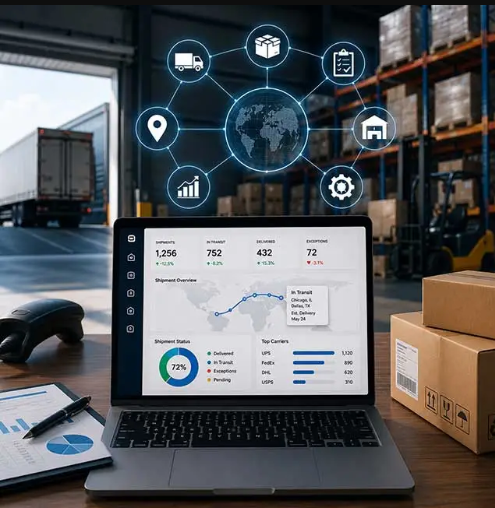
End-to-end visibility relies on processing real-time signals from GPS trackers, carrier APIs, and electronic data interchange systems. Integrating machine learning algorithms directly into the underlying platform allows businesses to generate predictive arrival times, identify spend anomalies, and dynamically optimize multi-stop delivery routes based on live traffic, weather disruptions, and capacity constraints.
Rapid Implementation through AI Frameworks
Traditionally, engineering custom enterprise platforms from scratch required 18 to 24 months of heavy technical development. Today, leading development providers streamline this process using pre-tested AI accelerator frameworks.
By configuring proven, battle-tested core components for transportation, warehousing, multi-carrier shipping, and fleet tracking, the initial platform infrastructure is deployed in weeks rather than years. Engineers then focus their efforts on writing custom logic, specialized workflow integrations, and unique user interface requirements. This accelerated approach reduces deployment timelines to 12 to 16 weeks while maintaining high code quality and enterprise reliability.
Conclusion
Transitioning to tailor-made digital infrastructure equips supply chain and freight operations with total control over their workflows, data, and technology strategy. Working with a dedicated software partner allows businesses to eliminate rigid software constraints, cut recurring license expenses, custom logistics software development scale operations rapidly. By modernizing legacy platforms with AI-driven routing, real-time shipment visibility, and automated warehouse management, enterprises build a resilient, future-ready supply chain capable of adapting to any market environment.